




Table of Contents
- French Terry vs Fleece: What's the Real Difference?
- Premium French Terry vs Fleece: A Side-by-Side Comparison
- What Is 430 GSM French Terry, and Why Does Weight Matter?
- French Terry vs Fleece Warmth: Which Keeps You Warmer?
- Durability and Care: How to Care for Premium Cotton Hoodies
- How to Tell Them Apart: A Visual Identification Guide
- Which One Should You Choose?
- Frequently Asked Questions
Last Updated: September 5, 2026
French Terry vs Fleece: What's the Real Difference?
The debate over premium french terry vs fleece comes down to a single question: do you want a fabric that breathes like a woven shirt or one that traps heat like a blanket? French terry is a knit fabric with smooth loops on the inside and a flat face, while fleece features a brushed pile that creates a soft, insulating layer. That structural difference drives everything else: warmth, weight, drape, and how the garment ages.

At PrevailX INC, we build our collections around 430 GSM French terry because it delivers a structured, luxurious feel that holds its shape season after season. Most guides treat these fabrics as interchangeable, but they serve different purposes entirely. French terry excels at all-season wear and moisture-wicking comfort, while fleece prioritizes maximum heat retention for static, cold-weather lounging.
Below, we'll break down the construction, warmth, durability, and care for each so you can decide which fabric matches your wardrobe goals.
Premium French Terry vs Fleece: A Side-by-Side Comparison
The fastest way to understand french terry vs fleece is to look at the inner surface of each fabric. French terry features exposed loopback threads that sit against your skin, creating small air pockets that regulate temperature. Fleece, by contrast, has a brushed pile: the fibers are mechanically lifted and sheared to create a dense, fuzzy layer that traps dead air for insulation.
That loopback structure is why French terry feels cooler in motion and warmer at rest. The loops allow airflow when you move, then close up to hold body heat when you sit still. Fleece has no such versatility; its brushed surface is engineered purely for heat retention.
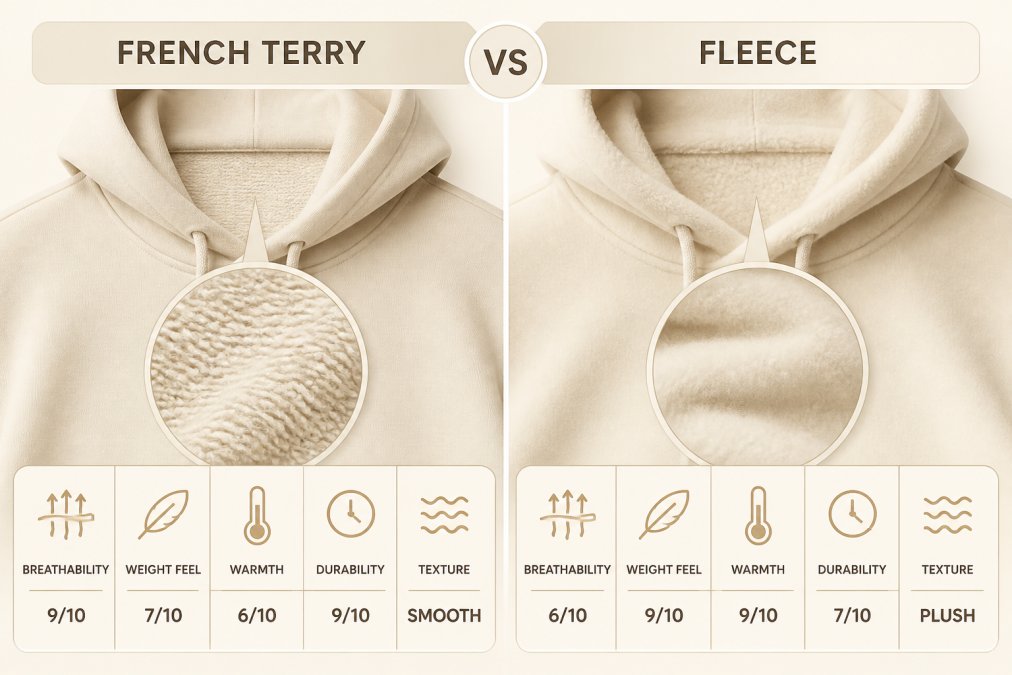
| Fabric | Inner Surface | Breathability | Warmth | Best Season | Drape |
|---|---|---|---|---|---|
| French Terry | Loopback loops | High | Moderate | All-season | Structured, holds shape |
| Fleece | Brushed pile | Low | High | Cold winter | Soft, relaxed |
Pros of French Terry: breathable, moisture-wicking, resists pilling, holds its silhouette, transitions between indoor and outdoor wear. Cons of French Terry: less insulating than fleece in extreme cold, heavier per layer of warmth.
Pros of Fleece: exceptional warmth-to-weight ratio, plush hand-feel, quick-drying. Cons of Fleece: prone to pilling, traps sweat during activity, loses structure over time, less versatile across seasons.
What Is 430 GSM French Terry, and Why Does Weight Matter?
GSM stands for grams per square meter, the standard measure of fabric density in textile manufacturing. A 430 GSM French terry is a heavyweight fabric: thick enough to feel substantial without the stiffness that plagues cheaper, lower-density knits. Most mass-market hoodies fall between 240 and 300 GSM, which is why they drape limply and lose their shape after a few washes.
Weight matters because it determines both comfort level and longevity. A 430 GSM fabric creates a structured garment that stands up on its own, with a clean drape that flatters rather than hangs. The higher fabric density also means the loopback construction holds its integrity longer, resisting the sagging and bagging that ruins lighter knits.
For context on how fabric weight affects performance, the Textile Institute's guidance on fabric weight classifications outlines how GSM ranges correlate with intended garment use. Heavier fabrics like 430 GSM are classified for outerwear and structured pieces, while lighter weights suit base layers.
French Terry vs Fleece Warmth: Which Keeps You Warmer?
For pure heat retention, fleece wins. The brushed pile creates millions of tiny dead air pockets that trap body heat against your skin, making it the superior choice for stationary cold-weather wear. French terry's loopback structure also traps air, but the open loops allow more airflow, which means less insulation.
The trade-off is breathability. French terry's moisture-wicking properties pull sweat away from the skin and let it evaporate, so you stay dry during activity. Fleece holds heat so effectively that it also holds moisture, leaving you clammy if you exert yourself. For a commute that involves walking, stairs, or any movement, French terry keeps you comfortable where fleece would overheat you.
This makes french terry vs fleece warmth a question of use case rather than a clear winner. For all-season wear, layering under a jacket, or transitioning between office and outdoors, French terry is the better thermal regulator. For sitting still in a cold room or short trips between car and building, fleece's insulation is hard to beat.
Durability and Care: How to Care for Premium Cotton Hoodies
Durability is where premium French terry separates itself from fleece, but the story goes beyond simple wear-and-tear. It extends into environmental impact and long-term garment life, a dimension most fabric guides ignore entirely.
The Pilling Problem in Fleece
Fleece pilling is not a random defect; it is a mechanical failure. The brushing process lifts and breaks individual fibers, creating a surface of loose ends. When friction occurs, from a backpack strap, a seatbelt, or the agitation of a washing machine, these loose ends tangle into the small balls you see on the surface. A 2023 industry report from the American Association of Textile Chemists and Colorists (AATCC) notes that pilling severity correlates directly with fiber length and surface brushing intensity (aatcc.org). Shorter, heavily brushed fibers pill faster.
French terry, by contrast, has a smooth face and intact loopback structure. The loops are continuous yarns, not broken ends, so there is nothing loose to tangle. This is why a 430 GSM French terry hoodie can withstand hundreds of washes without visible surface degradation, while a comparable fleece garment often thins and fuzzes within 20 to 30 wash cycles.
The Sustainability Angle No One Talks About
Most guides stop at 'which fabric feels softer?' They never ask: 'which fabric is better for the planet?' The answer is not as simple as 'cotton is natural, fleece is synthetic.'
- Carbon footprint: Conventional cotton production is water-intensive, but polyester fleece is petroleum-derived. A lifecycle assessment published by the Apparel Impact Institute in 2024 estimates that a polyester fleece hoodie generates roughly 25% more greenhouse gas emissions over its lifetime than a cotton French terry hoodie of equivalent weight, primarily due to raw material extraction and energy-intensive manufacturing.
- Microfiber shedding: This is fleece's hidden cost. Every wash releases microplastics into wastewater. A study from the Bren School of Environmental Science at UC Santa Barbara found that a single synthetic fleece jacket can shed up to 1.7 grams of microfibers per wash. French terry, being 100% cotton, sheds natural fibers that biodegrade.
- Longevity as sustainability: The most sustainable garment is the one you do not replace. Because French terry resists pilling and maintains its structure, it stays in rotation longer. The Sustainable Apparel Coalition's Higg Index rewards materials that extend product lifespan, and heavyweight cotton knits score favorably on durability metrics.
Care Protocols That Extend Lifespan
To protect a premium cotton hoodie and minimize environmental impact, follow these care steps:

- Turn the garment inside out before washing to shield the outer face from friction and reduce surface abrasion.
- Wash in cold water (60°F or below) on a gentle cycle with mild, plant-based detergent. Cold water also reduces energy consumption by up to 90% compared to hot water, per the U.S. Department of Energy.
- Skip fabric softeners entirely. They coat cotton fibers with a waxy residue that reduces moisture-wicking performance and attracts dirt. Use a half-cup of white vinegar in the rinse cycle instead if you need softening.
- Air dry flat on a drying rack. If you must use a dryer, select the lowest heat setting and remove the garment while slightly damp. High heat shrinks cotton loops unevenly and accelerates fiber breakdown.
- Store folded, not hung. Hanging stretches shoulder seams over time, distorting the structured drape that defines heavyweight French terry.
- Use a fabric shaver sparingly on fleece if you own both fabrics. For French terry, never use a shaver on the loopback interior, it will catch and pull loops, creating runs.
The Environmental Trade-Off, Honestly Stated
French terry is not perfect. Cotton farming uses significant water and pesticides unless certified organic. The Organic Trade Association reports that organic cotton uses 91% less water than conventional cotton. If environmental impact is your priority, look for GOTS-certified organic French terry or recycled cotton blends.
Fleece, however, has one advantage: it is often made from recycled PET bottles. A recycled polyester fleece diverts plastic from landfills. But the microfiber shedding problem remains, and recycled polyester still requires energy-intensive processing.
The honest conclusion: for longevity, reduced microplastic pollution, and lower lifetime emissions, premium French terry is the more sustainable choice. For a budget-friendly, warm layer made from recycled materials, fleece has a place. The Apparel Impact Institute's fiber sustainability index provides a deeper breakdown of these trade-offs for readers who want to dig further.
How to Tell Them Apart: A Visual Identification Guide
You can identify french terry vs fleece in under ten seconds with two quick tests. First, look at the inside of the fabric. French terry shows a repeating pattern of small loops, similar to the back of a towel but finer. Fleece shows a uniform, fuzzy surface with no visible pattern, like the inside of a winter hat.
Second, run your hand across the inner surface. French terry feels textured and slightly nubby from the loopback threads. Fleece feels smooth and plush, like stroking a soft animal. If you gently pull at the inner surface, French terry loops will stretch and retract, while fleece's brushed fibers simply separate.
A third test involves the outer face. French terry has a smooth, flat appearance that resembles a traditional t-shirt fabric. Fleece often shows a subtle nap, a directional texture that appears lighter or darker depending on the viewing angle. This nap is a direct result of the brushing process.
Which One Should You Choose?
The decision between premium French terry and fleece comes down to your priorities: versatility, longevity, and skin comfort versus maximum warmth and plush softness. But there is one factor most guides never mention: how each fabric interacts with your skin.
Skin Sensitivity and Hypoallergenic Properties
If you have sensitive skin, eczema, or contact dermatitis, the choice matters more than you might think.
French terry is the hypoallergenic winner. The loopback structure is made from 100% cotton, a natural plant fiber that is inherently breathable and free from synthetic irritants. The National Eczema Association recommends cotton as the preferred fabric for people with eczema because it is soft, breathable, and does not trap heat or sweat against the skin. Cotton also has a neutral pH, which helps maintain the skin's natural acid mantle.
Fleece presents several concerns for sensitive skin:
- Synthetic fibers: Most fleece is polyester, a petroleum-derived plastic. While the brushed surface feels soft, it does not breathe like cotton. Trapped sweat and heat can trigger flare-ups in people prone to heat rash or eczema.
- Chemical residues: Polyester manufacturing involves chemical treatments, including dyes and finishes that can off-gas or leach. Some people report itching or redness when wearing unwashed synthetic garments.
- Static electricity: Synthetic fleece generates static cling, which can be uncomfortable and irritating for those with dry or sensitive skin.
- Microfiber abrasion: The brushed pile, while soft to the touch, can feel scratchy to hypersensitive individuals after prolonged wear, especially if the fleece has begun to pill.
A common pattern dermatologists observe is that patients with sensitive skin tolerate natural fibers like cotton far better than synthetics. The American Academy of Dermatology advises choosing loose-fitting, soft, natural fabrics like cotton for people with eczema, and avoiding wool and synthetic materials that can irritate.
A Decision Framework Based on Your Priorities
| Your Priority | Choose | Why |
|---|---|---|
| All-season versatility | French Terry | Breathable loops regulate temperature across 8+ months of the year |
| Maximum warmth for static wear | Fleece | Brushed pile traps dead air for superior insulation |
| Sensitive skin or eczema | French Terry | Natural cotton is hypoallergenic and breathable |
| Longevity and shape retention | French Terry | Loopback structure resists pilling and sagging |
| Lightweight warmth on a budget | Fleece | Exceptional warmth-to-weight ratio at lower cost |
| Moisture management during activity | French Terry | Wicks sweat away and allows evaporation |
| Softest possible hand-feel | Fleece | Brushed pile is undeniably plush |
| Environmental sustainability | French Terry | Natural fibers biodegrade; no microplastic shedding |
The Verdict for Most Buyers
For most people, premium French terry is the better investment because it performs across more scenarios and respects your skin. Its breathability makes it wearable for eight months of the year rather than three, and its resistance to pilling and sagging means it still looks sharp after dozens of washes. The heavyweight construction of a 430 GSM garment also provides a comfort level that feels substantial without the bulk of layered fleece.
If you have ever experienced itching, redness, or heat rash from synthetic fabrics, French terry is the clear choice. If you live in a climate with harsh winters and spend most of your time indoors in cold rooms, fleece's insulation is hard to beat, just be prepared for more frequent replacement and potential skin irritation.
If you want a piece that signals quiet strength, holds up to daily wear, and feels comfortable against sensitive skin, the PrevailX collection of 430 GSM French terry hoodies delivers exactly that. Each hoodie, from the PrevailX Luxury Graffiti Black Hoodie at $120 to the Brown French Terry Heavy Weight Hoodie with Leather Accents at $135, is constructed from heavyweight cotton with precise stitching and premium detailing. Free shipping applies on orders over $150, and the heavy-weight garment construction ensures these pieces endure as symbols of resilience.

Frequently Asked Questions
Which is better, fleece or French terry?
Neither is universally better; it depends on your priorities. French terry excels in breathability, drape, and year-round versatility, making it ideal for layering and moderate climates. Fleece provides superior thermal insulation due to its brushed pile, making it the warmer choice for cold-weather lounging. For a premium, structured garment that transitions between seasons, 430 GSM French terry offers a balance of comfort and refined aesthetics.
Is French terry like fleece?
Both are knit cotton fabrics, but their construction differs significantly. French terry has a smooth exterior and distinctive loopback on the inside, which enhances breathability. Fleece has a brushed pile on one or both sides that traps dead air pockets for heat retention. This difference makes French terry more versatile for all-season wear, while fleece is better suited for colder conditions. The loopback of French terry is a hallmark of its quality and structure.
Does French terry shrink more than fleece?
Both fabrics can shrink if not cared for properly, but the outcome differs. To care for your premium cotton hoodie and minimize shrinkage, always wash in cold water and tumble dry on low or lay flat to dry. High heat is the primary culprit. A high-quality, pre-shrunk 430 GSM French terry will hold its shape and structure better than a lighter-weight fleece, which is more prone to distortion and pilling over time.
Is premium French terry more durable than standard fleece?
Yes, premium French terry is generally more durable. The tight knit construction and higher GSM, such as 430 GSM, create a denser fabric that resists pilling, snagging, and losing its shape. Standard fleece, often lighter and with a brushed surface, is softer but can flatten, pill, and show wear more quickly. Investing in heavyweight French terry ensures your garment maintains its structure and appearance for years, justifying a higher price point.
Choosing between french terry vs fleece ultimately comes down to how you live in your clothes. If you need a fabric that moves with you through changing environments and holds its form for years, premium French terry is the clear winner. PrevailX builds every piece from 430 GSM French terry with structured silhouettes, leather and twill accents, and a purpose-driven design meant to reflect your journey. Explore the collection and find a hoodie that carries your story with the weight it deserves.


