

Quick Summary
Premium hoodie quality shows in fabric weight, knit structure, stitching and finishing. Heavyweight fabric around 400 GSM or more is a useful starting point, but seams, stress-point reinforcement and fit after washing confirm whether a hoodie was built to last.
- Basic fast-fashion hoodies are roughly 280 to 320 GSM, while heavyweights typically start around 400 GSM.
- Count stitches per inch on a one-inch span and check that spacing is consistent.
- Look for bar tacks at pocket corners, since single straight lines without tacks tend to open with use.
- Pull the shoulder seam firmly; a well-built seam springs back while a weak one gapes.
- Wash the hoodie once per the care label and re-measure chest, body and sleeve length to test shrinkage.
Table of Contents
- What Separates a Premium Hoodie From a Basic One
- Understanding Hoodie Fabric Weight and GSM
- Why French Terry Hoodie Quality Depends on Knit and Finish
- How to Check Hoodie Stitching Quality
- A Hoodie Fit Guide for Judging Shape and Sizing
- A Practical At-Home Inspection Checklist
- Choosing Your Next Premium Hoodie at PrevailX
- Frequently Asked Questions
What Separates a Premium Hoodie From a Basic One
Most hoodies look similar on a rack, so the difference in premium hoodie quality shows up in the details.
Start with the fabric, then check how it was put together. Fabric weight, fiber content, knit structure, stitching and finishing all affect how the garment performs.
The most useful way to judge a hoodie is to test several of these markers at once. A heavy fabric with weak seams still fails, and a light fabric with excellent construction can outperform it.
Understanding Hoodie Fabric Weight and GSM
GSM, or grams per square meter, measures how much fabric a square meter weighs. Higher numbers mean denser, heavier cloth. A 2026 buying guide from Legendary Branding describes most fast-fashion hoodies as roughly 280 to 320 GSM and says heavyweight hoodies typically start around 400 GSM, with some reaching 500 GSM (Legendary Branding 2026 hoodie buying guide).
Weight tells you how much material went into the garment and roughly how warm and substantial it will feel. It does not tell you how the material was knit or finished.
Why Weight Alone Does Not Guarantee Quality
Heavier fabric can still be poorly made. A dense cloth with loose knitting, uneven dyeing or cheap seams can feel impressive in the store and disappoint after a few wears. Construction, fit and finishing are generally regarded as equally important to fabric weight.
Use GSM as a starting filter. A 430 GSM French terry hoodie, like the Prevailx Luxury Hunter Green Hoodie | 430 GSM French Terry with Leather Accents, gives you a heavyweight baseline, but you still need to check the stitching, knit and finish to confirm premium hoodie quality before deciding.

Why French Terry Hoodie Quality Depends on Knit and Finish
French terry is a looped knit, usually cotton, with loops on the reverse side and a smoother face. Its quality depends on how tightly the loops are formed, the fiber content and how the fabric is finished after knitting.
Check the inside face too. Good French terry is typically brushed or softened so it feels comfortable against skin, without fuzz that breaks down in a few washes. Heavy weight is a useful signal here, but the knit structure and finishing decide whether that weight feels luxurious or merely heavy.
How to Check Hoodie Stitching Quality
Stitching is where many premium claims are tested, and it is also where you can get objective fastest. Seams carry the load every time you pull the garment on and off, so inspect them at the stress points first: the shoulder-to-sleeve join, the underarm gusset area, the hood-to-neckline join, the armhole, and the side seams near the hem.
Stitch density and seam type
Stitch density is the number of stitches per inch. You can count stitches per inch with a ruler against a seam on the inside of the garment, pick a one-inch span and count the diagonal or straight stitches.
Seam type tells you how the load is carried. A basic hoodie often uses a simple overlock (serged) seam, which finishes an edge but does not reinforce it. Better construction uses a flatlock or coverstitch on stretch seams and a double-needle topstitch along shoulders and hems.
Stress-point reinforcement
At each stress point, check three things: whether the seam is double-stitched or bar-tacked, whether the seam allowance is wide enough not to fray, and whether the stitch line sits flat without puckering. Bar tacks, short, dense zigzag stitches, are common at pocket corners, drawstring eyelets, and the base of a kangaroo pocket, where pull forces concentrate. If a pocket corner has only a single line of straight stitching and no tack, expect it to open with use.
Hardware and trim checks
Hardware matters most on zip-up and drawstring styles. A quality zipper runs smoothly without catching, has teeth that align cleanly when zipped, and uses a pull that feels solid rather than flimsy. Metal zippers generally outlast molded plastic on heavyweight garments, but the slider and tape quality matter more than the tooth material alone. Drawstring ends should be finished, aglets, knotted tips, or folded-and-stitched ends, so they do not fray, and the eyelets should be reinforced with stitching or a metal grommet so they do not tear through the fabric.
What the labels and tags tell you
Care and content labels are part of the construction story. A label that lists fiber percentages, country of assembly, and a specific care regimen signals a manufacturer tracking its inputs. A vague label with no fiber breakdown is a warning that the fabric may be a blend chosen for cost rather than performance. None of this replaces the physical checks above, but it is a fast filter before you start counting stitches.
Prevailx Luxury Graffiti Black Hoodie | 430 GSM French Terry with Zippers →
The article points to a few stitching checks you can run on a hoodie before you buy, each tied to a specific stress point.
| Check | What to look for | Why it matters |
|---|---|---|
| Stitch density | Count stitches per inch on a one-inch span | Consistent spacing shows good machine tension |
| Shoulder seam pull | Firm perpendicular pull on the seam | A well-built seam springs back; a weak one gapes |
| Pocket corners | Bar tacks at the corners | Single straight lines without tacks tend to open |
| Drawstring ends | Aglets, knots or folded ends | Stops fraying at the tips |
| Hood and neckline join | Stretching or rippling | Signals construction defects |
A Hoodie Fit Guide for Judging Shape and Sizing
Fit is a quality question as much as a style one, because a well-cut hoodie keeps its shape through the body, sleeves, and hood after washing, not just on the hanger. Judge fit in two stages: the dry fit before washing, and the post-wash fit that tells you what you actually bought.
The dry-fit checks
Check that the shoulder seam sits near the natural shoulder point rather than dropping halfway down the arm (unless the cut is intentionally oversized). The sleeves should hang without twisting, a twisted sleeve usually means the fabric was cut off-grain, which also predicts skewing after washing. The hem should sit straight and level, and the hood should sit cleanly without collapsing when you turn your head. Pull the cuffs and hem ribbing and release: quality ribbing recovers its shape within a few seconds; sagging ribbing will only get worse.
Shrinkage: what to expect and how to test it
Cotton knits shrink, and the amount depends on how the fabric was pre-shrunk and finished. You cannot read a reliable shrinkage percentage off a hangtag, so test it yourself: measure the chest width, body length, and sleeve length flat before washing, wash once per the care label, dry as directed, and re-measure.
Shape retention and seam distortion
After washing, check the side seams for skew, do they spiral toward the front or back? Skew comes from off-grain cutting and is a construction defect, not a washing error. Check the neckline and hood join for stretching or rippling, and check the cuffs and hem for ribbing that has lost its snap. Heavy fabric should recover after you stretch the cuffs or hem; if the ribbing stays stretched, expect the same after every wash.
Fit differs by hoodie type
Construction and fit cues vary by style, so judge each on its own terms:
- Pullover: the kangaroo pocket and hood join carry the most stress; check pocket bar tacks and hood seam reinforcement. Fit should allow layering without the body ballooning at the hem.
- Zip-up: the zipper is the fit-critical component. Zip it fully and check that the two front panels align without rippling, that the zipper does not pull the hem out of level, and that the collar sits flat when zipped. A zipper installed on a stretched or off-grain panel will pucker permanently.
- Fleece-lined: the lining adds bulk and reduces stretch, so fit runs closer to the body measurement. Check that the lining is attached at the cuffs and hem so it does not ride up, and that the shell and lining shrink at similar rates, mismatched shrinkage causes the lining to bag.
- French terry: the looped back gives more stretch and recovery than fleece, so it holds fit better through the body. Check that the loops are tight and uniform and that the fabric springs back when pressed; loose, flat loops predict a garment that stretches out at the elbows and hem.
A Practical At-Home Inspection Checklist
When a hoodie arrives, run through these checks before you wear it:
- Note the GSM on the product page and compare it with the fabric you feel in hand.
- Press the fabric. Does it spring back, or does it look flat and stretched?
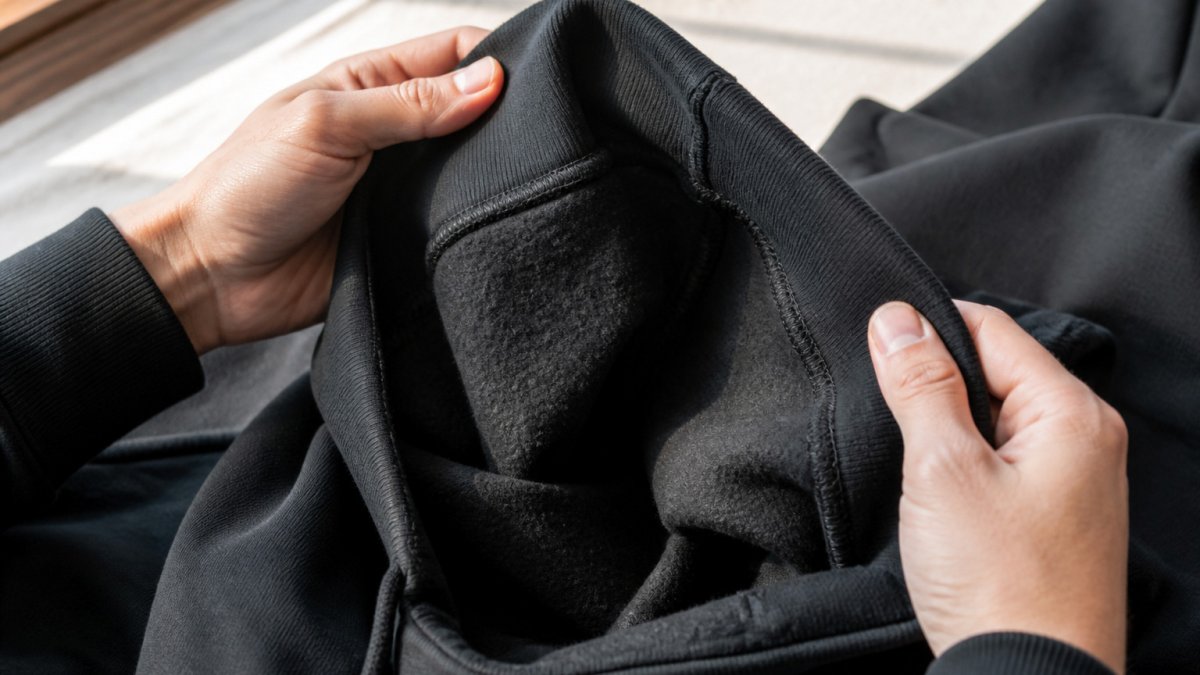
- Turn the hoodie inside out. Look for even stitching, reinforced seams and clean finishing.
- Check the cuffs and hem. The ribbing should recover its shape after you stretch it.
- Test the hood. It should sit cleanly and not collapse or distort when you move your head.
- Test the hardware. Zippers should run smoothly and drawstrings should move freely.
- Wash it once, following the care label, and check for shrinkage, pilling or color loss.
Repeat the wash test before judging long-term value. A single wear tells you little about durability.
Choosing Your Next Premium Hoodie at PrevailX
If you are ready to apply these checks, start by browsing the PrevailX hoodie collection and compare fabric weight, construction and details across the range. Each piece is built around 430 GSM French terry, so the comparison comes down to finish, color and design.
Our pick for a practical heavyweight option is the Prevailx Luxury Graffiti Black Hoodie | 430 GSM French Terry with Zippers, which pairs heavyweight French terry with functional side zippers. Run it through the inspection checklist above, and judge it on the same criteria you would use for any premium piece.
Frequently Asked Questions
How can you tell if a hoodie is high quality?
Start with the fabric: a heavier knit usually feels denser and holds its shape better than thin jersey. Then inspect the stitching for even, tight seams with no loose threads, check that ribbed cuffs and hems recover after stretching, and look at fit and finish. None of these checks alone proves quality, but together they give a reliable picture before you buy.
Does a heavier hoodie mean better quality?
Not automatically. Fabric weight measured in GSM is a useful indicator of density and warmth, and a commercial buying guide describes most fast-fashion hoodies at roughly 280 to 320 GSM, with heavyweight options starting around 400 GSM. Weight matters only alongside fiber content, knit construction, stitching and finishing, so treat it as one signal rather than a guarantee.
What does GSM mean for hoodies?
GSM stands for grams per square meter and measures how much fabric weighs over a set area. Higher GSM generally means a denser, warmer, more structured fabric. Because the number reflects weight rather than quality, compare GSM across hoodies with similar fiber content and construction, and combine it with a check of seams and fit.
Are French terry hoodies good quality?
French terry can be an excellent choice. Its looped knit structure is a common construction for hoodies. Quality depends on the yarn, the knit density and the finishing, so inspect the surface for even loops and check how the fabric recovers after a gentle stretch. The PrevailX Graffiti Black and Brown French Terry hoodies, both built from 430 GSM French terry, are examples of this construction.
How should a quality hoodie fit?
Fit is one factor to consider when evaluating a hoodie, alongside fabric and construction. Compare the garment measurements with a size chart rather than relying on the label alone.


